Community platform field guide
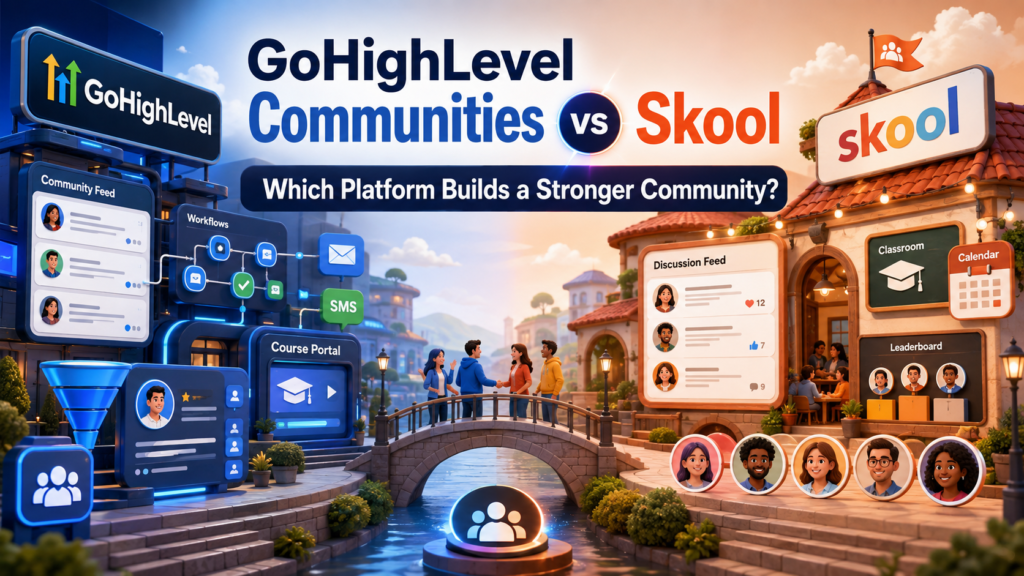
GoHighLevel Communities vs Skool Platform: Which Builds a Stronger Member Business?
The GoHighLevel Communities vs Skool platform comparison is not simply all-in-one software versus a community app. It is a choice between two operating philosophies: HighLevel connects community activity to a wider CRM and marketing system, while Skool removes distractions and makes participation the center of the product.
A lively community can increase course completion, reduce cancellations, create referrals, and turn customer questions into reusable knowledge. Yet more features do not automatically create more engagement. Members return when the experience is clear, rewarding, and consistently useful.
HighLevel wins the connected-business test
Best when community access, courses, contacts, funnels, email, SMS, appointments, payments, and sales automation need to work as one system.
Skool wins the focused-experience test
Best when creators want a simple community, classroom, calendar, leaderboard, native calls, and potential Discovery exposure without building a complex technology stack.
[rank_math_toc]

This guide is part of our GoHighLevel software comparisons and alternatives collection. Platform features and prices change, so confirm final details before subscribing.
The Community Flywheel: Five Moments That Determine the Winner
Instead of beginning with a long feature checklist, this comparison follows a member through five moments: discovery, joining, participation, progress, and renewal. A platform is valuable only when it helps members move through that complete cycle.
The member-community flywheel
Discover → Join → Participate → Progress → Renew and Refer → Discover
Moment 1: How New Members Discover the Community
Skool: Native Discovery Is a Meaningful Advantage
Skool has a built-in Discovery system where eligible communities can appear by category. According to Skool’s documentation, rankings consider member growth, activity, and retention. Quality presentation, authentic engagement, and active administrators can help, while spam, fake accounts, weak support, and off-platform payments may hurt visibility.
This does not guarantee free traffic. New groups must reach activity thresholds, and competition varies by niche. Still, Skool gives creators a potential acquisition channel inside the product. That is valuable for a coach or educator who does not already own a large email list.
HighLevel: Build and Own the Acquisition Journey
HighLevel’s approach is broader. A business can attract prospects through websites, funnels, forms, calendars, advertisements, email, text messaging, and CRM follow-up before granting community access. This offers far more control over the conversion journey, but the owner usually must create or buy the traffic.
HighLevel also connects communities and courses to its GoKollab ecosystem, although the central advantage remains the ability to control the audience journey from lead capture through paid membership.
Winner for built-in community discovery: Skool.
Winner for customizable lead generation and follow-up: HighLevel.
Moment 2: Joining, Checkout, and Member Access
Skool supports free groups, subscriptions, freemium communities, tiered paid plans, and one-time payments. It also supports one-time course purchases. The joining experience stays close to the community, which reduces the number of pages a creator must assemble.
HighLevel allows businesses to combine payment products, funnels, forms, workflows, community groups, and course offers. It supports paid groups and paid courses, including one-time and recurring arrangements. Workflow actions can grant course access automatically, and access-related triggers can begin a welcome or onboarding sequence.
Practical distinction: Skool makes it easier to sell access to the community itself. HighLevel makes it easier to sell a broader customer journey in which the community is one component.
Moment 3: Daily Participation and Conversation
Skool’s strongest design decision is restraint. Community posts, categories, comments, member profiles, chat, classroom, calendar, and leaderboard sit inside a consistent interface. Members who belong to several Skool groups already understand the navigation. That familiarity reduces training and makes the platform feel like a destination rather than an add-on.
HighLevel Communities supports posts, comments, channels, private channels, chat, events, member management, themes, and community customization. Recent workflow triggers can also react to activities such as new posts, comments, event registration, and rejected join requests. That creates useful operational possibilities: notify a moderator, tag an engaged member, initiate event follow-up, or alert an account manager.
Skool is generally more polished for a creator whose product is the community experience. HighLevel is more flexible when the community must exchange data with sales, service, and marketing operations.
Moment 4: Learning, Progress, and Gamification
Both platforms combine community and educational content, but their incentive systems deserve closer inspection.
How Skool Gamification Works
Skool members earn points when other members like their posts or comments. Accumulated points move members through nine levels, and administrators can make courses unlock at selected levels. The mechanism encourages useful posting because other members—not merely the act of posting—generate the points.
Skool also includes group leaderboards. Creators can use level-locked courses, resources, or events to reward constructive participation. The system is easy for members to understand and closely integrated into the platform’s identity.
How HighLevel Gamification Works
HighLevel Communities provides points, badges, levels, leaderboards, and rewards. Owners can associate rewards with milestones, including course access, promotional discounts, or exclusive roles. Workflows can react to group-access and leaderboard events, which allows gamification to affect activity outside the community itself.
HighLevel also offers course access options such as direct purchase, subscriptions, time-based unlocking, and automated offer grants. Its strength is not just motivating a member inside a group; it is connecting progress to a larger customer record and automation system.
Winner for simple, immediately understandable gamification: Skool.
Winner for configurable automation around member progress: HighLevel.
Moment 5: Renewal, Retention, and Re-Engagement
Retention depends on relevance, relationships, and visible progress. Skool helps owners monitor the community behavior that drives its Discovery ranking and provides tools such as AutoDM and cancellation video on Pro. Its familiar feed, calendar, calls, and leaderboard keep the retention system straightforward.
HighLevel can combine community behavior with CRM follow-up. A workflow could respond to event registration, group access, course enrollment, or other member actions; send an email or SMS; create a task; update a custom field; or move an opportunity. This matters when a business needs to distinguish an inactive member from a high-value coaching client, sales prospect, or account at risk.
Automation should support human relationships rather than flood members with messages. A personal check-in triggered by meaningful inactivity can improve retention. Five generic reminders often create the opposite result.
GoHighLevel Communities vs Skool Feature Comparison
| Community Requirement | GoHighLevel Communities | Skool |
|---|---|---|
| Primary design | Community inside an all-in-one CRM and marketing platform | Focused community and learning platform |
| Discussion | Posts, comments, channels, private channels, chat | Posts, comments, categories, chat, profiles |
| Courses | Courses, paid offers, subscriptions, timed access | Unlimited courses, Classroom, one-time purchases, level unlocks |
| Gamification | Points, badges, levels, leaderboards, configurable rewards | Points, nine levels, leaderboards, level-locked courses |
| Events and calls | Community events plus wider calendar and appointment tools | Calendar, recurring events, Skool Call; webinars on Pro |
| Native discovery | GoKollab listings available; acquisition commonly uses funnels and campaigns | Discovery ranking based partly on growth, activity, and retention |
| CRM and pipelines | Native CRM, opportunities, conversations, workflows | Not a full native sales CRM; Pro offers Zapier connection |
| Best fit | Agencies, coaches, client portals, multi-product businesses | Creators and educators prioritizing community simplicity |
Pricing: The Subscription Is Only Half the Equation
Skool currently offers two plans. Hobby costs $9 per month and Pro costs $99 per month. Both advertise unlimited members, courses, videos, and live calls. The major economic difference is the payment fee: Skool’s pricing page lists a 10% transaction fee for Hobby and 2.9% for Pro. Its payment documentation adds a 30-cent per-transaction charge and describes a higher percentage on Pro transactions above $900.
HighLevel currently lists Starter at $97 per month, Unlimited at $297 per month, and Agency Pro at $497 per month. Annual rates are shown as $970, $2,970, and $4,970. Starter includes three sub-accounts; Unlimited and Agency Pro include unlimited sub-accounts. Email, SMS, calling, AI, and certain premium services may generate usage charges.
$9 monthly platform fee
10% transaction fee
$99 monthly platform fee
2.9% transaction fee*
About $1,268 in monthly sales before considering identical per-transaction charges
Illustration: the $90 monthly plan-price difference divided by the 7.1 percentage-point fee difference. This is not a quote. *Skool documents different Pro fees for transactions above $900; taxes, refunds, international considerations, and other costs may affect actual results.
At low revenue, Skool Hobby is an inexpensive way to validate a community. As sales grow, the transaction fee becomes more important. HighLevel costs more than Hobby before usage, but it may replace a CRM, funnel builder, email automation platform, scheduler, phone system, and other subscriptions.
If courses are the primary product, also review gohighlevel vs kajabi for course creators and gohighlevel vs clickfunnels 2.0 course hosting.
The Community Operator Test
Choose the statement that sounds most like your business.
“I Want Members Talking to One Another Quickly”
Lean toward Skool. Its concentrated interface, recognizable navigation, simple leaderboard, and Classroom make it easier to explain where members should go and what they should do.
“I Need Community Activity Connected to Sales and Service”
Lean toward HighLevel. Contacts, conversations, opportunities, calendars, workflows, payments, and community access can live inside the same operating environment.
“I’m Launching My First Paid Community With Little Revenue”
Lean toward Skool Hobby for validation. The $9 entry price is difficult to beat, although the 10% transaction fee should be modeled before the community grows.
“My Agency Will Deploy Communities for Multiple Clients”
Lean toward HighLevel Unlimited or Agency Pro. Separate sub-accounts and reusable systems align more naturally with multi-client delivery than purchasing and administering unrelated communities one by one.
“I Want Marketplace-Like Organic Discovery”
Lean toward Skool. Discovery can create incremental visibility when the community earns engagement and retention. Do not treat it as a substitute for building an audience you control.
“I Want a Branded Customer Portal With Automated Upsells”
Lean toward HighLevel. It offers more control over funnels, messaging, access rules, follow-up, and the wider customer lifecycle. The tradeoff is greater setup complexity.
What Neither Platform Can Automate for You
Software cannot manufacture belonging. Before choosing a platform, define the community promise in one sentence: who it helps, what members achieve, and why they need one another to achieve it.
- A recurring reason to return: weekly feedback, office hours, accountability, new resources, or peer collaboration.
- A useful first action: introduce yourself, post a goal, book orientation, or complete a short lesson.
- Visible member progress: a milestone, badge, completed project, revenue result, certification, or contribution.
- Active moderation: fast answers, clear rules, spam control, and constructive discussion.
- Member-to-member value: the community should remain useful even when the owner is not posting.
A 30-Day Community Launch Plan
- Days 1–3: Define the member promise, ideal member, first measurable win, and community rules.
- Days 4–7: Build the welcome path, orientation lesson, introductions prompt, calendar, and support process.
- Days 8–12: Preload useful discussions and invite a small founding cohort personally.
- Days 13–17: Run the first live event and observe where members become confused or inactive.
- Days 18–22: Add reminders only at the points where members actually stall.
- Days 23–26: Introduce a progress reward tied to meaningful behavior rather than empty posting.
- Days 27–30: Interview active and inactive members, improve onboarding, and publish the next monthly rhythm.
For another community-focused alternative, compare gohighlevel vs podia community building.
Migration Checklist: Moving a Community Without Losing Trust
Community migration is not merely a data export. Members have habits, bookmarked lessons, private messages, event schedules, progress, and payment expectations.
- Inventory members, roles, subscriptions, courses, posts, files, events, and integrations.
- Confirm which content and data can be exported from the existing platform.
- Map products, access levels, recurring billing dates, and cancellation terms.
- Rebuild essential courses and onboarding before announcing the move.
- Invite a test group and resolve login, mobile, payment, and notification problems.
- Give members a clear reason, deadline, and step-by-step migration guide.
- Keep the old community readable during a transition period when practical.
- Run a welcome event inside the new platform to establish the new habit.
Want Your Community Connected to Your Entire Customer Journey?
Use the HighLevel trial to build one group, one course, one access workflow, and one re-engagement sequence. Test the complete member experience before migrating your audience.
Start a 14-Day GoHighLevel Trial
Affiliate disclosure: Local Resource Hub may earn a commission if you purchase through this link, at no additional cost to you.
Frequently Asked Questions
Is GoHighLevel Communities better than Skool?
HighLevel is generally better when the community must connect to CRM records, funnels, sales pipelines, email, SMS, appointments, and agency sub-accounts. Skool is generally better when simplicity, community engagement, native Discovery, and a focused member experience are the priorities.
Is Skool cheaper than GoHighLevel?
Skool Hobby currently costs $9 per month and Pro costs $99 per month. HighLevel Starter currently costs $97 per month. However, Skool charges transaction fees, while HighLevel may add communication and other usage costs. Compare the entire software stack and expected sales volume.
Can GoHighLevel host paid communities?
Yes. HighLevel supports paid community groups and paid courses, with payment and access options that can be connected to its CRM and workflows.
Does Skool include unlimited members and courses?
Skool’s current pricing page advertises unlimited members, courses, videos, and live calls on both Hobby and Pro plans.
Which platform has better gamification?
Skool’s point, level, leaderboard, and level-unlock system is exceptionally simple for members to understand. HighLevel offers points, badges, levels, leaderboards, rewards, and workflow connections, making it more configurable for complex business processes.
Can Skool replace a CRM?
Skool contains member profiles and community-management information, but it is not a complete sales CRM comparable to HighLevel. Businesses needing pipelines, multichannel conversations, lead nurture, and detailed customer automation will generally need another system.
Does Skool have built-in live calls?
Yes. Skool Call is included in both plans according to its current event documentation. Skool Webinar is identified as a Pro feature.
Which platform is better for agencies?
HighLevel is usually the stronger agency choice because Unlimited and Agency Pro support unlimited sub-accounts and provide tools for deploying broader marketing and CRM systems for clients. Skool may still be chosen when a client’s main requirement is a focused creator community.
Final Verdict: GoHighLevel Communities or Skool?
Skool is the better pure community product for many creators. Its focused interface, Classroom, calendar, native calls, leaderboard, level-based rewards, and Discovery system make it easier to launch a place members quickly understand. The $9 Hobby plan also creates an unusually accessible starting point, although its transaction fee becomes important as revenue grows.
HighLevel is the stronger community business system. It becomes more valuable when community membership must influence CRM records, messaging, appointments, sales opportunities, course access, payments, funnels, or agency client accounts. It can consolidate more software, but owners must invest more thought in configuration and member experience.
The most honest conclusion to GoHighLevel Communities vs Skool platform is this: choose Skool when community is the product; choose HighLevel when community is one important part of a connected customer journey.