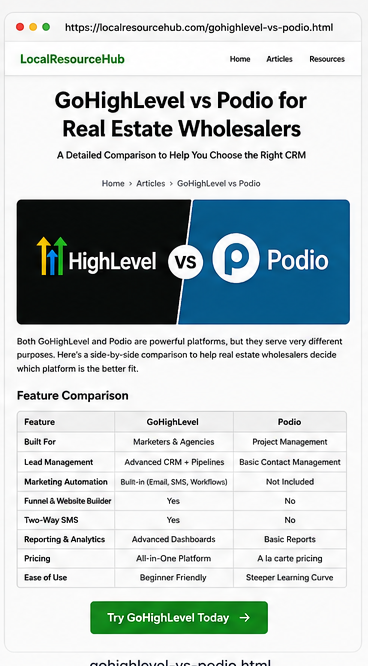
The most useful way to compare GoHighLevel and Podio for real estate wholesaling is not to ask which CRM has “more features.” The better question is which operating model you want. GoHighLevel is designed around contacts, conversations, opportunities, forms, calendars, campaigns, and automated workflows. Podio is a flexible work platform that can be shaped into a wholesaling CRM with custom apps, fields, relationships, and workflow automation. Both can manage seller leads, but they encourage different system architecture.
- Decision summary for wholesalers
- Lead intake and acquisitions workflow
- Automation and follow-up
- Dispositions and buyer management
- Reporting, customization, migration, and best-fit scenarios
GoHighLevel vs Podio: the short answer
Choose GoHighLevel when your highest-value problem is consistent lead response and follow-up across phone, SMS, email, forms, calendars, and a visible sales pipeline. Its architecture makes it natural to trigger a workflow when a lead submits a form, enters through an integration, replies to a message, changes pipeline state, or hits another event. For a wholesaler, that means the CRM can actively push the next action instead of simply storing the record.
Choose Podio when your highest-value problem is building a deeply customized internal workspace. Podio can represent properties, sellers, buyers, offers, contracts, tasks, vendors, and transactions as connected app items. Its workflow automation can react to item creation or updates, apply filters, create tasks, update records, send emails, and run date-based actions. That flexibility is valuable for operators with a mature process and someone who can own the configuration.
| Decision area | GoHighLevel | Podio | Wholesaler implication |
|---|---|---|---|
| Core model | Contact + conversation + opportunity pipeline | Custom apps/items + relationships | GHL is faster for sales follow-up; Podio is more database-like. |
| Lead nurture | Built around automated multi-step workflows | Possible through workflow automation and connected tools | GHL generally reduces the number of moving parts for nurture. |
| Custom operations | Strong custom fields, pipelines, workflows, custom objects in supported configurations | Very flexible app construction and field relationships | Podio is attractive for bespoke operational data structures. |
| Web forms / funnels | Native lead-capture ecosystem | Usually assembled with Podio forms or external front ends | GHL is often simpler for direct-response marketing. |
| Team adoption | Sales CRM style | Workspace/database style | Training needs depend on how heavily Podio is customized. |
Lead intake: marketing CRM versus configurable workspace
Wholesaling lead intake is deceptively complex. A motivated seller may arrive from PPC, a cold-call transfer, direct mail, a landing page, a purchased lead, a referral, or a property data platform. The CRM needs to normalize that lead, preserve source attribution, assign an owner, start follow-up, and make the record visible to acquisitions. GoHighLevel is naturally oriented around this sequence because incoming contacts and form or webhook events can enter workflows that update fields, create or move opportunities, assign users, and send messages.
Podio can absolutely hold the same information. A custom “Seller Leads” app can include property address, seller name, phone, motivation, condition, asking price, campaign, offer amount, appointment date, status, and acquisition manager. The advantage is schema freedom: if your team wants a field, relationship, calculation, or linked app, the workspace can be designed around it. The tradeoff is that the operator has to decide how every major interaction becomes data and how external communication tools feed the system.
Follow-up automation is the biggest practical gap
A wholesaler does not lose most deals because the CRM lacks a field. Deals are lost when leads are contacted too slowly, warm prospects are forgotten, acquisition managers fail to schedule the next touch, or old leads never re-enter a nurture sequence. GoHighLevel’s workflow model is aimed at exactly this class of problem. A lead can enter through an inbound webhook, be tagged by source, receive an immediate acknowledgement, create an opportunity, notify the assigned rep, wait for a response, branch on behavior, and continue into a long-term nurture campaign.
Podio Workflow Automation also supports meaningful automation. It can trigger on item creation or updates, filter on field values, create and update items, assign tasks, send emails, and execute date-driven workflows. This is powerful for internal process control. The difference is one of center of gravity: GoHighLevel treats communication automation as a core CRM experience, while Podio treats the workspace and its records as the foundation upon which workflows are built.
Acquisitions pipeline management
In GoHighLevel, wholesalers can model stages such as New Lead, Attempting Contact, Contacted, Appointment Set, Offer Made, Follow-Up, Under Contract, Dead, and Long-Term Nurture. The pipeline is not just a visual board. Stage changes can become automation triggers or consequences of other automations, which reduces the gap between what the acquisition manager does and what the system does next.
In Podio, a similar process can be represented as a category field or linked app workflow. The benefit is that a single lead can carry extensive structured data and connect to other objects. A property can be related to a seller, a buyer, a contract, and a task app. This can be excellent for a sophisticated operation. However, every additional customization becomes something the business owns, documents, tests, and maintains.
Dispositions: neither platform should be judged only by the seller side
Wholesaling ends with a buyer or an exit strategy, so a CRM decision needs to include dispositions. GoHighLevel can maintain a cash-buyer contact segment using tags, custom fields, smart lists, and workflows. A contracted property can trigger internal notifications or marketing steps, while buyer responses can be tracked in the conversation record. It is workable for operators who want seller and buyer communications in the same broad ecosystem.
Podio can be more granular when the team creates dedicated Buyers, Properties, Offers, and Transactions apps. A buyer record can be related to preferred ZIP codes, price ranges, property types, proof-of-funds status, and prior transactions. That structure can help a disposition manager search or filter buyers according to a property. But again, the quality of the outcome depends heavily on the quality of the workspace design.
Reporting and attribution
For most wholesalers, actionable reporting starts with five questions: where did the lead come from, how quickly did the team respond, how many conversations became appointments, how many appointments became contracts, and which channels produced gross profit. GoHighLevel can capture source and opportunity data alongside communication activity, making it easier to build a marketing-and-sales view without stitching together as many interfaces.
Podio reporting can be useful for record-centric operational dashboards, but many businesses pair it with external reporting or spreadsheet layers when they need deeper marketing attribution. That is not inherently a weakness; it is a design choice. A team that already has dedicated phone, ad attribution, BI, and communication systems may prefer Podio as the central operational database.
Customization, maintenance, and “CRM debt”
The hidden cost of any CRM is configuration debt. A custom system can become extremely valuable, but it also becomes dependent on naming conventions, field logic, integrations, and the person who understands why everything was built that way. Podio’s flexibility increases both the ceiling and the responsibility. Before choosing it, decide who will own the schema, workflow rules, permissions, app relationships, and documentation.
GoHighLevel can also become overbuilt. The safer approach is to keep one source-of-truth field for each key concept, use a small number of pipeline stages that correspond to real decisions, and reserve automation for repeatable actions. HighLevel snapshots can help teams duplicate proven configurations, which is especially useful for multi-market or multi-brand operators who want consistency.
Which platform fits which wholesaler?
| Wholesaler profile | Better starting fit | Why |
|---|---|---|
| Solo operator who needs automated follow-up | GoHighLevel | Fewer systems between lead capture, pipeline, communication, and nurture. |
| Small acquisitions team with inconsistent speed-to-lead | GoHighLevel | Workflow-first architecture can enforce response and task sequences. |
| Operations-heavy team with unique data relationships | Podio | Custom apps and linked records can mirror complex internal processes. |
| Business with an existing mature Podio build | Depends | Migration value must exceed the cost of rebuilding years of logic. |
| Multi-market team that wants repeatable CRM deployment | GoHighLevel | Reusable snapshots can standardize configurations across sub-accounts. |
How to migrate from Podio to GoHighLevel without breaking follow-up
Start by inventorying your Podio apps and identifying which data actually influences sales decisions. Do not automatically recreate every legacy field. Export seller contacts, property data, lead source, status, assigned user, last contact date, next follow-up date, and any notes required by acquisitions. Then define the GoHighLevel contact fields and opportunity stages that will become the new source of truth.
Build the pipeline and workflows before importing production leads. Test with synthetic records that represent a new lead, an appointment, a pending offer, a long-term nurture lead, and a contracted deal. Confirm that assignments, notifications, messages, stop conditions, and pipeline movements work as expected. Only after that should you import active leads in batches. Keep the old system read-only for a defined transition period so the team can resolve data questions without running two live processes indefinitely.
Final verdict
GoHighLevel and Podio can both support a serious wholesaling business, but they solve the problem from opposite directions. GoHighLevel starts with a marketing and sales CRM and lets you build wholesaling logic through pipelines, fields, forms, conversations, and workflows. Podio starts with a flexible workspace and lets you model wholesaling through custom apps and automation. If the business needs reliable seller response and nurture with fewer connected systems, GoHighLevel is usually the more direct route. If the business’s competitive advantage depends on an unusually customized operations database, Podio may still be the better foundation.
See GoHighLevel for Your Wholesaling WorkflowFrequently asked questions
Is GoHighLevel or Podio better for a new wholesaling operation?
GoHighLevel is usually easier when the priority is a ready-to-configure CRM plus messaging, pipelines, forms, calendars, and automated follow-up. Podio can be a strong fit when the operator wants to design a highly custom database-style workspace and is comfortable assembling more of the surrounding stack.
Can Podio automate real estate wholesaling workflows?
Yes. Podio Workflow Automation supports triggers, filters, actions, date-based triggers, task creation, item updates, email actions, and document generation. The practical difference is that wholesalers often configure the business system around Podio rather than starting from an all-in-one marketing CRM.
Does GoHighLevel replace every wholesaling tool?
No. It can consolidate CRM, pipeline, forms, calendars, messaging, websites or funnels, and many automations, but list data, specialized skip tracing, comps, title work, transaction coordination, and other investor tools may still come from separate systems.
Can I migrate from Podio to GoHighLevel?
Yes, but treat the move as a data-model and workflow migration rather than a simple screen-for-screen copy. Export contacts and deal data, map fields and stages, recreate automations, test messaging consent and attribution, then cut over in controlled batches.