GoHighLevel vs InvestorFuse CRM Comparison
A real-estate-investor-focused GoHighLevel vs InvestorFuse CRM comparison covering pipelines, KPIs, automation, team workflows, pricing, migration and the InvestorFuse-to-CarrotCRM transition.
Last updated:
GoHighLevel vs InvestorFuse CRM: what changed in 2026
The first thing to know about this comparison is that InvestorFuse’s own website now states that InvestorFuse is CarrotCRM. That matters because someone searching “GoHighLevel vs InvestorFuse CRM” may be comparing HighLevel against a product name that is transitioning into Carrot’s CRM ecosystem. The underlying buying question is still valid: should a real estate investor use a broad all-in-one marketing and CRM platform, or a CRM designed more specifically around investor lead management, KPIs, tasks and follow-up?
HighLevel approaches the problem from the outside in. It combines lead capture, websites, funnels, forms, calendars, conversations, workflows and pipelines so the same platform can acquire, nurture and manage opportunities. InvestorFuse/CarrotCRM approaches it from inside the acquisitions operation. Its public materials emphasize campaign-level KPI tracking, contracts, workflows, scorecards, inbound call popups, resurfacing and team-oriented action management. If your team primarily needs acquisitions discipline, the specialized CRM can be attractive. If you want one platform to own both marketing execution and sales follow-up, HighLevel has the broader footprint.
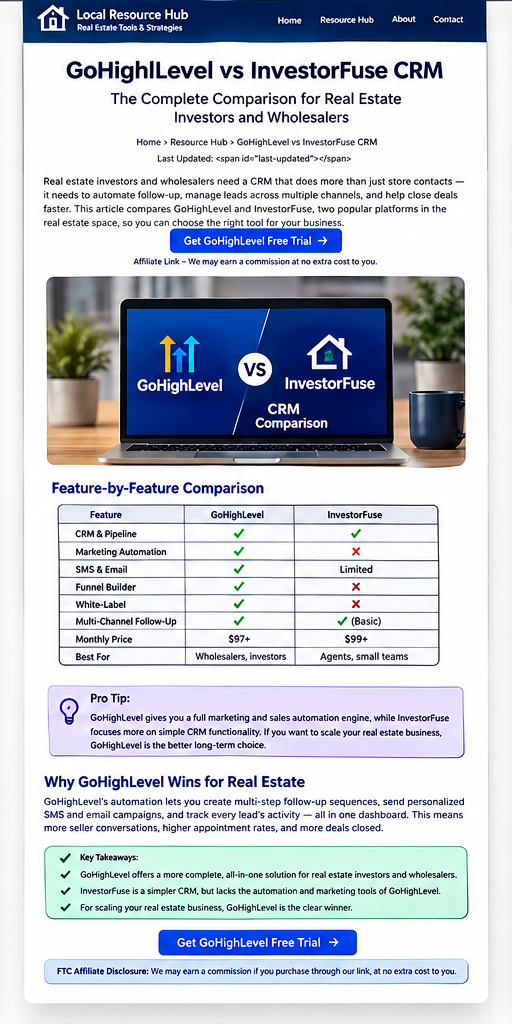
| CRM decision factor | HighLevel | InvestorFuse / CarrotCRM | Practical implication |
|---|---|---|---|
| Product scope | Sales, marketing, automation, communications, funnels and CRM. | Real-estate-investor CRM with operations, KPI and follow-up focus. | HighLevel consolidates more of the marketing stack; InvestorFuse is more specialized. |
| Pipeline management | Configurable opportunities and pipeline stages. | Investor-oriented lead lifecycle and action system. | Both can manage acquisitions; specialized terminology may reduce setup time in InvestorFuse. |
| Automation | Broad workflow builder spanning forms, messages, tasks and pipeline events. | Pro plan publicly lists workflows, campaign autoresponders and resurfacing. | HighLevel is generally stronger when automation must cross marketing and CRM layers. |
| KPI orientation | Reporting and opportunity data depend on configuration. | Public site emphasizes cost per lead, signed contract and closed deal tracking. | InvestorFuse has an investor-specific measurement story out of the box. |
| Current published monthly entry point checked | $97 Starter. | $147/month Essentials; higher tiers add workflows and team features. | Compare required tier, onboarding and add-ons rather than entry price alone. |
| Best fit | Operators wanting one acquisition-to-nurture marketing system. | Teams prioritizing investor CRM process, scorecards and action management. | The winner depends on whether marketing consolidation or CRM specialization is the larger need. |
Pipeline design: the real test of a wholesaling CRM
A real estate wholesaling CRM should make the next revenue action obvious. It is not enough to store a contact and an address. The system should show whether the seller has been reached, whether motivation and timeline are known, whether underwriting is complete, whether an offer has been made, when the next follow-up is due, and who owns the opportunity. Both HighLevel and InvestorFuse can support structured pipelines, but they arrive from different product philosophies.
HighLevel is highly configurable. That is powerful, but it creates a blank-canvas problem. A team can build exact stages such as New Lead, Attempting Contact, Qualified, Underwriting, Offer Made, Follow-Up, Contract Signed and Closed. It can also build bad stages such as “Hot,” “Warm,” and “Cold” without clear exit criteria. InvestorFuse’s investor orientation can reduce some of that ambiguity because its features and KPI language are closer to an acquisitions department’s daily work.
Automation depth versus operational specialization
HighLevel’s strongest argument is breadth. A seller form can create a contact, create an opportunity, assign an owner, send an acknowledgement, trigger a task, add a tag, start a nurture sequence and later stop the sequence when the seller replies. That gives an operator one workflow canvas for front-end response and back-end pipeline movement. It is particularly useful when the wholesaling company also manages paid ads, landing pages, calendars, email campaigns and SMS inside the same account.
InvestorFuse’s public Pro tier lists campaign autoresponders, workflows, resurfacing, inbound call popups, saved views, a mini dashboard and scorecards. The product also emphasizes KPI tracking across the lead lifecycle, including cost per lead, cost per signed contract and cost per closed deal. For a team that already has marketing sources configured and needs a system to discipline acquisitions activity, those investor-specific operational features can be more important than having a native funnel builder.
Pricing: compare the tier that contains the workflow you need
HighLevel’s public pricing currently lists Starter at $97 per month, Unlimited at $297 and Agency Pro at $497. Starter includes the core platform and three sub-accounts, while higher tiers are oriented toward agencies, unlimited sub-accounts, API access, rebilling and SaaS capabilities. A wholesaler using HighLevel for one investing company may not need the agency-specific value of the top tiers.
InvestorFuse’s pricing page currently shows monthly Essentials at $147 for one user, Pro at $247 for five users and a Premium Beta tier displayed at $377 promotional pricing against a $497 reference price. The page also lists additional users at $20 per month and additional integrations at $10 per month on a separate add-on page. Because the product is transitioning to CarrotCRM, confirm packaging and onboarding before calculating a multi-year total cost.
The more meaningful comparison is required-tier cost. If the InvestorFuse features you want—such as workflows or campaign autoresponders—sit in Pro, compare that price against the HighLevel plan you actually need. Then add implementation, phone/email usage, data migration and any integration middleware. A CRM that is cheaper but requires two extra systems to deliver the same workflow may have a higher total operating cost.
Lead source attribution and investor KPIs
Wholesalers need more than a count of leads. A channel can generate a large number of cheap inquiries and still be a poor investment if few become signed contracts. InvestorFuse explicitly markets campaign KPI tracking across the lead lifecycle. That makes metrics such as cost per lead, cost per signed contract and cost per closed deal central to its story. This orientation is valuable because it forces the team to connect acquisitions activity back to marketing economics.
HighLevel can track opportunities, pipeline movement and source data, but the quality of reporting depends heavily on architecture. UTM parameters, lead-source fields, opportunity values, stage definitions and close reasons need to be normalized. If every form writes a different source label, reports become noisy. The upside is flexibility: operators can connect the same attribution model to landing pages and workflows that also live in HighLevel. The downside is that someone must design it.
Team management and the “your day” problem
A good acquisitions CRM should answer a simple morning question: what must each person do today? InvestorFuse’s materials emphasize scorecards, dashboards, action systems, saved views and weighted round robin in higher tiers. That language reflects a sales-management use case: supervisors want consistency and reps want a queue of prioritized actions. For organizations with several acquisitions people, a specialized action-management experience can be a meaningful advantage.
HighLevel can create tasks, ownership rules, pipeline filters, notifications and automated assignments, but its broad feature set means the team can become distracted by configuration. The best HighLevel implementation for a wholesaler is usually intentionally narrow on the user-facing side. Reps should not need to understand every marketing feature. They need a clean pipeline, their assigned leads, a conversation history, a next task and a small number of reliable automations.
Integrations and migration risk
Migration should be evaluated as a data project, not a subscription change. Export contacts, opportunities, notes, tags, custom fields, tasks and lead-source history. Identify data that will not map cleanly. Decide whether old call recordings or message histories need to remain accessible. Create a freeze date after which new records are created only in the target system. Test duplicate rules before importing the complete database.
InvestorFuse’s current transition to CarrotCRM makes this especially important for long-term planning. A rebrand or product consolidation is not inherently negative, but it is a reason to ask direct questions about roadmap, migration, support, integrations and the relationship between legacy InvestorFuse plans and current CarrotCRM packaging. HighLevel has its own platform risk: a very broad system can create dependency across many functions, so clean exports and documented workflows remain essential.
Who should choose HighLevel?
HighLevel is the stronger fit when the business wants to consolidate landing pages, forms, calendars, SMS, email, pipeline management and nurture automation; when speed-to-lead is a major problem; when the same operations person will own marketing systems and CRM automation; or when the company runs multiple brands or business units that benefit from sub-account architecture. It is also attractive to teams that want to reduce Zapier-style handoffs among multiple point solutions.
It is a weaker fit when the team does not have anyone capable of owning configuration and governance. Unlimited flexibility can create unlimited inconsistency. Without standardized fields, stage definitions and automation naming, the account becomes difficult to report on and risky to change.
Who should choose InvestorFuse / CarrotCRM?
The specialized CRM is compelling when the company already has working websites, phones and marketing sources, but acquisitions execution is inconsistent; when investor-specific KPIs and rep scorecards are central to management; when the team values an opinionated action system over a general marketing toolbox; or when a dedicated real estate investor CRM requires less custom configuration than HighLevel.
Its tradeoff is stack breadth. If you still need separate landing-page software, email marketing, SMS tooling, scheduling and automation middleware, the specialization may increase the number of vendors in the revenue stack. That can be a good trade if each component is best-in-class and reliable, but the company should make that choice deliberately.
A migration scorecard before you decide
| Question | Weight | HighLevel score | InvestorFuse / CarrotCRM score |
|---|---|---|---|
| Can the system make every new lead’s next action obvious? | High | Score after building your actual pipeline. | Score after testing your actual acquisitions queue. |
| Can it preserve lead source through signed contract and close? | High | Test field and reporting architecture. | Test campaign KPI reporting. |
| Can automations stop cleanly when a human takes over? | High | Test reply/goal/condition logic. | Test workflow and autoresponder controls. |
| How many external tools remain mandatory? | Medium | Often fewer because of broad native scope. | Potentially more depending on your marketing stack. |
| How quickly can a new acquisitions rep become productive? | Medium | Depends on how cleanly the account is configured. | Specialized workflow may reduce training friction. |
Frequently asked questions
Is InvestorFuse still available?
InvestorFuse’s current website says InvestorFuse is now CarrotCRM. Buyers should confirm current packaging, migration options and support directly with the vendor.
Is GoHighLevel a real estate investor CRM?
HighLevel is a broad CRM, marketing and automation platform rather than a wholesaling-only CRM. It can be configured around a real estate investor pipeline.
How much does InvestorFuse cost?
The current InvestorFuse pricing page shows monthly Essentials at $147 and Pro at $247, with higher-tier options also listed. Pricing may change as the product transitions to CarrotCRM.
Which is better for a multi-person acquisitions team?
InvestorFuse/CarrotCRM has a specialized investor operations story, while HighLevel offers broader automation and marketing consolidation. Test both against your real pipeline, tasks, attribution and reporting needs.
← Back to the GoHighLevel Real Estate Wholesaling pillar guide