GoHighLevel vs Carrot Landing Pages
Compare GoHighLevel vs Carrot landing pages for real estate wholesaling, including SEO, lead capture, CRM handoff, automation, pricing and the best fit for motivated-seller funnels.
Last updated:
GoHighLevel vs Carrot landing pages: the short answer
For a real estate wholesaler, this comparison is less about which company makes “better pages” in the abstract and more about where the landing page sits inside your seller-lead system. Carrot is a purpose-built website and SEO platform with a long history in real estate investing. Its current Individual plan is positioned around one high-converting site, automated location pages, basic SEO tools and rank tracking, with Carrot CRM included. HighLevel is a broader sales and marketing platform: its Starter plan combines websites and funnels with forms, calendars, CRM records, pipelines, workflow automation, email and SMS capabilities. That makes HighLevel more attractive when the page is only the first step in a tightly automated acquisition workflow, while Carrot remains compelling when your primary objective is a real-estate-specific content site and local organic search program.
The practical distinction is ownership of the next action. A Carrot page can capture a motivated seller very well, but the operator still needs to decide how the lead is routed, how quickly it receives a response, what record becomes the source of truth, and how long-term nurture happens. HighLevel tries to keep those steps in the same environment. If your business has lost deals because forms, inboxes, texting tools and spreadsheets do not agree with one another, consolidation can be more valuable than squeezing a slightly different conversion rate out of a page template.
Feature-by-feature comparison for wholesaling landing pages
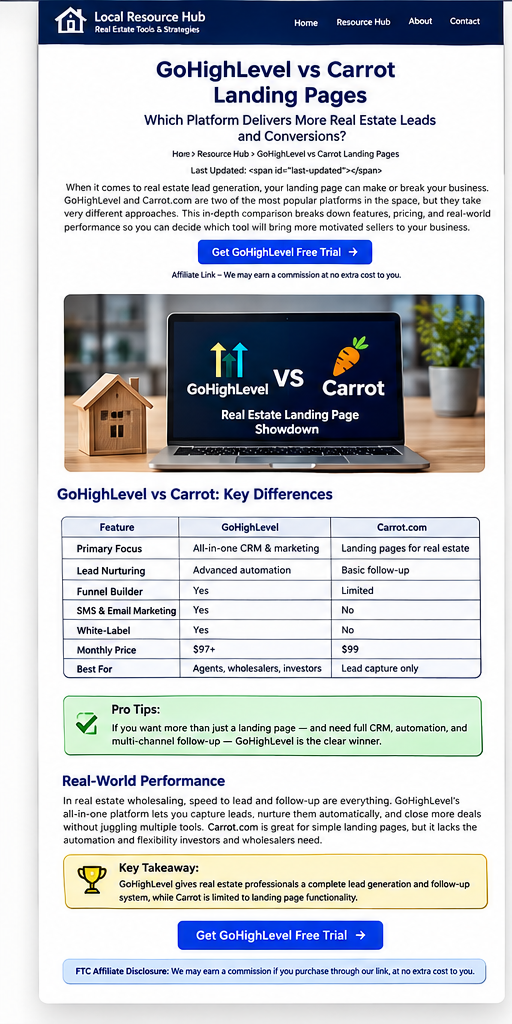
| Decision factor | HighLevel | Carrot | What it means for a wholesaler |
|---|---|---|---|
| Primary product orientation | CRM, funnels, automation and communications platform | Real-estate-focused website, SEO and lead-generation platform | Choose based on whether the site itself or the capture-to-follow-up system is the larger problem. |
| Landing page / site builder | Websites and funnels are included among core tools. | High-converting real estate site included in current Individual plan. | Both can publish lead-capture experiences; Carrot is more purpose-built for investor websites. |
| Local SEO orientation | Possible through site content and SEO tooling, but not the central product identity. | Automated location pages, SEO tools and rank tracking are prominent in current packaging. | Carrot is easier to justify when organic local search is the strategic center of the site. |
| CRM and pipeline | Native contact records, opportunities, pipelines and workflows. | Carrot’s current site plan advertises free Carrot CRM, but the website product remains the front-end emphasis. | HighLevel offers a more unified handoff between page submission and sales process. |
| SMS/email follow-up | Built into the broader platform with usage-based communication considerations. | Often handled through CRM functions or connected tools depending on setup. | Map the whole nurture path before comparing monthly subscription prices. |
| Published entry price checked for this guide | $97/month Starter. | $99/month billed annually for Individual. | Base price is close enough that workflow fit usually matters more than a small subscription difference. |
Pricing and packaging are based on the vendors’ public pages checked for this batch: HighLevel lists Starter at $97/month, while Carrot’s sign-up page lists Individual at $99/month billed annually. Vendor terms can change, so verify before purchase.
Where Carrot is genuinely strong
Carrot deserves credit for specializing in a problem many investors underestimate: creating a credible real estate investing site that can rank for local intent and convert homeowners without feeling like a generic agency funnel. The current product positioning emphasizes automated location pages, SEO tools and rank tracking. For an operator building a portfolio of “sell my house fast” pages, neighborhood pages and educational content, this specialization reduces the amount of blank-page strategy work. You start closer to the language, architecture and conversion patterns used by investors.
That focus also creates operational simplicity. If your team already has a CRM it trusts, already has calling and texting configured, and already has well-maintained automations, replacing the website layer with an all-in-one system can create needless migration risk. In that case, keeping Carrot as the acquisition site and passing clean form data to the established CRM can be the more disciplined choice. Programmatic consolidation is not automatically better than a stable integration.
Where HighLevel changes the economics of a landing page
HighLevel becomes more interesting when a “landing page” is really the front door to a sequence. A motivated seller submits an address and phone number. The contact record is created. An opportunity enters a new-lead stage. An acquisitions rep is assigned. The seller receives an immediate acknowledgement. A task is created for a call. If the call is missed, a controlled nurture path continues. If the seller replies, automation stops and a human takes over. This is the operating model HighLevel is designed to support.
That does not mean every possible automation should be turned on. A page that triggers six messages, multiple voicemails and a calendar link within five minutes can destroy trust. The advantage of one connected system is visibility and orchestration, not volume. For real estate wholesalers, the strongest implementation usually starts with a short acknowledgment, one ownership notification, one task and a carefully timed follow-up sequence with reply-based stop conditions.
Conversion design: what matters more than the logo on the builder
Wholesaling landing pages succeed when they reduce uncertainty. The homeowner should immediately understand who the page is for, what happens after submitting information, and why providing property details is worth the effort. A strong page usually has one primary action, a short explanation of the selling process, credibility signals, privacy reassurance, local context and a form that asks only for information the acquisitions team will actually use. These principles apply in both HighLevel and Carrot.
The difference is what happens after the form. If your team manually exports leads, retypes phone numbers into a dialer or checks a shared inbox to determine ownership, your highest-impact optimization may be post-form operations rather than button color or headline wording. HighLevel’s native pipelines and workflows can remove those handoffs. Carrot’s advantage is that it can give a real estate investor a more opinionated starting point for SEO-focused site structure. Decide which bottleneck is costing more deals today.
SEO strategy and cannibalization
For organic search, avoid publishing dozens of near-identical city pages that differ only by place name. A local landing-page system needs enough unique market context, seller scenarios, transaction details, service boundaries and supporting internal links to justify each URL. Carrot’s automated location-page capability can accelerate deployment, but scale should not replace editorial differentiation. The same warning applies to HighLevel sites or any other CMS.
On this site, this page intentionally targets the product-comparison intent “GoHighLevel vs Carrot landing pages.” It should not try to rank for a general HighLevel review, a Carrot review, or a broad “best CRM for wholesalers” query. Maintaining that separation keeps the cluster useful and reduces internal competition. The pillar page covers the broad HighLevel-for-wholesalers decision; this cluster exists only for people specifically choosing a landing-page stack.
Cost comparison: subscription price is only layer one
HighLevel’s public pricing lists Starter at $97 per month with three sub-accounts, unlimited contacts and unlimited users among the headline terms. Carrot’s current sign-up page lists an Individual plan at $99 per month when billed annually, including one site, automated location pages, basic SEO tools and rank tracking, plus free Carrot CRM. Those numbers are close enough that a rigorous comparison should look at total workflow cost rather than base subscription alone.
Count the other software required to achieve the same seller journey: forms, calendars, texting, email, pipeline tracking, call routing, integrations, automation middleware and reporting. Then count administrative cost. If a virtual assistant spends hours reconciling lead sources, that labor belongs in the comparison. Conversely, if your team already runs a high-performing CRM and only needs a site, the “all-in-one” value of HighLevel may be redundant.
Which one should a real estate wholesaler choose?
Choose Carrot first when your strategic priority is a real-estate-specific website with an SEO-led acquisition model, your back-end CRM process is already mature, and you want a specialized starting point for investor content and location pages. Choose HighLevel first when the bigger constraint is fragmented lead handling: disconnected forms, inconsistent SMS/email follow-up, unclear pipeline ownership, multiple scheduling tools or difficulty tracing a seller from first touch to next action.
A hybrid is also legitimate. Some investors use a specialized website at the top of the funnel and a broader CRM/automation system behind it. The important rule is to define one source of truth for lead status and one owner for each handoff. If both platforms are collecting partial contact records without clear synchronization, the stack becomes more fragile rather than more powerful.
A 7-step trial test for this exact comparison
- Choose one seller landing page with meaningful traffic and duplicate its essential message in HighLevel.
- Keep the offer, form length and traffic source as similar as possible so the test is not distorted by different creative.
- Create pipeline stages for new lead, attempting contact, qualified, offer made, nurture and closed/lost.
- Assign one acquisitions owner and one escalation rule for unworked leads.
- Build a conservative first-response workflow with reply stop conditions.
- Track form completion, speed-to-lead, contact rate, qualified-lead rate and percentage of records with a clear next action.
- Compare operational friction as well as conversion performance before deciding whether to migrate the broader site.
Frequently asked questions
Is GoHighLevel better than Carrot for landing pages?
HighLevel is usually stronger when you want the landing page tightly connected to CRM, pipelines, calendars and multi-channel automation. Carrot is especially strong for real-estate-specific websites and SEO-led local lead generation.
How much do GoHighLevel and Carrot cost?
HighLevel currently lists Starter at $97 per month. Carrot currently lists Individual at $99 per month billed annually. Pricing and included features can change, so verify each vendor before buying.
Can I use Carrot with HighLevel?
Yes. A specialized front-end website can send leads into a separate CRM and automation platform. The key is to define one system of record and test the integration carefully.
Which platform is better for real estate wholesaling SEO?
Carrot has a more explicit real-estate and local-SEO orientation. HighLevel can host sites and funnels, but its differentiator is broader marketing, CRM and workflow consolidation.
← Back to the GoHighLevel Real Estate Wholesaling pillar guide